The bending of light from its straight path due to massive objects is known as gravitational lensing. Sometimes this distortion can look like a ring around the massive body which is called an Einstein ring (see the image below).
 |
Credits:- Lensshoe_hubble.jpg: ESA/Hubble & NASA derivative work: Bulwersator (talk) |

In our high school, we learned that light always travels in a straight line, then you will be thinking how can light bend. What's happening here is that, the space around the object is curved. This is same as how a car/bike turns slowly if the road is slanted.
 |
| pixabay |
The ability to bend space around an object increases with mass, hence black holes are a powerful lens. Since the amount of lensing depends on the mass we can use it to weigh clusters, galaxies. Similarly, light travelling closest to its center deviates more compared to the light travelling furthest to its center. This GIF shows lensing by a black hole.
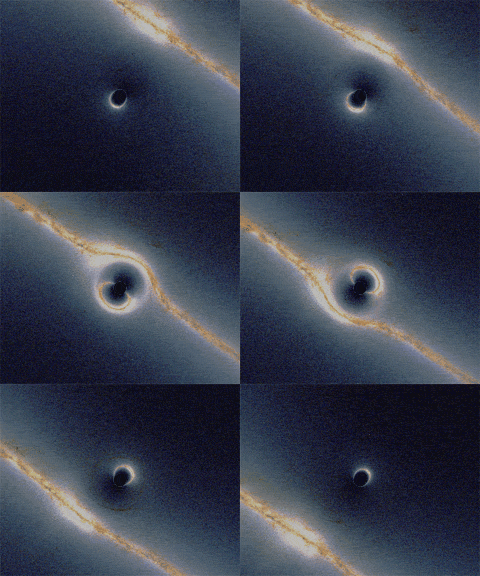 |
| Credits: Urbane Legend (optimised for web use by Alain r) (CC BY-SA 3.0) https://creativecommons.org/licenses/by-sa/3.0/deed.en |
Light passing near the edges of these bodies converges to a point. This helps us to use them as a magnifying glass which can be used to look at distant galaxies.
Einstein predicted that we can use sun as a gravitational lens which has a focal point of around 542 astronomical units (1 astronomical unit (AU) equal to average distance between earth and sun, 150 M km). This means if we had a probe at this distance then we could use sun as a gravitational lens (voyager is still only 149 AUs away).
For checking out top 8 scary space images, click here.
Smiling Lens
 |
Credits: NASA & ESA, Acknowledgement: Judy Schmidt (geckzilla.org) (CC BY 4.0) https://creativecommons.org/licenses/by/4.0/ |
Well explained.. This is really interesting.
ReplyDelete